How AI Agents Are Transforming Digital Marketing Automation
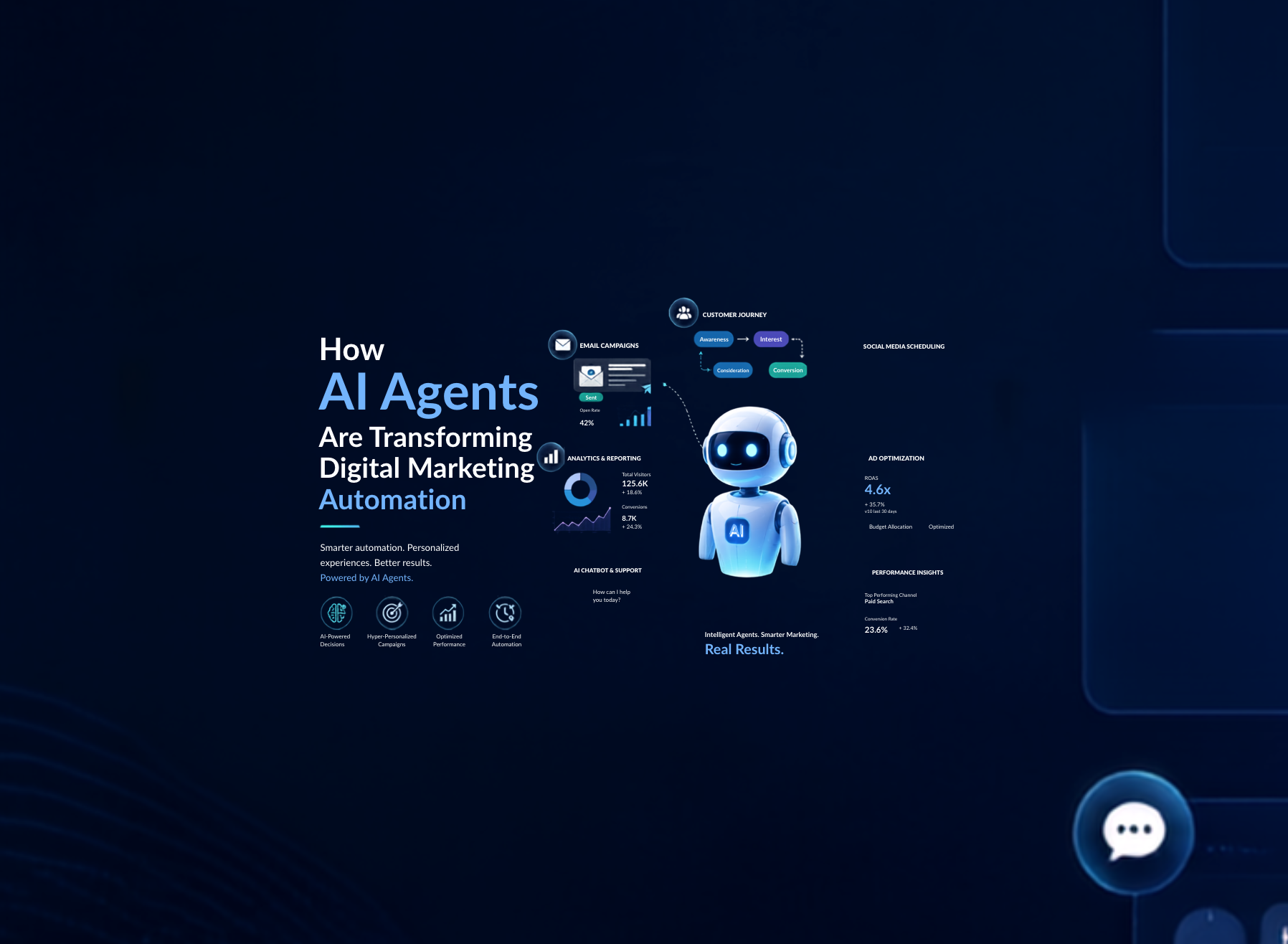
In the past, marketing had clear guidelines. If a lead clicked on a link, then you waited two days and sent an email. That’s how the game was played for well over a decade. But AI-based marketing automation is slowly moving away from these guidelines into something that is smarter. Rather than being dependent on guidelines and having a marketer click the “send” button, the new technology can comprehend the end result and figure out how to achieve it.
This change is known as agents of AI in digital marketing, and it is revolutionizing everything from campaign creation to content writing and lead nurturing to how marketers themselves are spending their time. And this change is not for the future; it is happening right now in 2026.
What Is Agentic AI, and Why Does It Matter?
Agentic AI refers to those AI-driven solutions that do not limit themselves to completing a particular task following an initial prompt. Traditional AI would be able to produce one letter after receiving a request. However, an agent will create a whole process, customize it depending on target segments, analyze users’ reactions, and adapt further prompts by itself.
This can be explained by a rather straightforward idea: whereas traditional automation moves through a predefined route, agentic solutions have an initial aim and the ability to define the path toward it and improve it based on incoming information.
How Do AI Marketing Agents Work?
The majority of AI marketing assistants use a cycle that operates endlessly:
Perceive: the assistant collects information about the campaign using CRM, analytics dashboards, advertising platforms, and content performance.
Reason: it identifies what works, what doesn’t work, and how to proceed further.
Act: the assistant implements the step immediately by changing the budget for the advertisement, by sending a reminder, or by updating content.
Learn: it studies the result of this action and incorporates it into its decision-making process next time.
This cycle is the reason why marketing automation by means of AI feels like a partner who never stops monitoring the campaign.
AI Agents vs Marketing Automation: What’s the Real Difference?
This comparison comes up constantly, and for good reason, the two aren’t the same thing, even though they get used interchangeably.
Traditional Marketing Automation | AI Agents |
Follows pre-set rules and triggers | Works toward a goal and decides its own steps |
Needs a human to build every workflow | Can build and adjust workflows on its own |
Reacts the same way every time | Learns and changes its approach over time |
Good for repetitive, predictable tasks | Good for complex, shifting situations |
The point about this comparison of AI agents against marketing automation is not one replacing the other. Marketing departments will continue to use automation software as the underlying base, and then AI agents will be used above it to make better decisions about it.
Where AI Agents Are Making the Biggest Impact
AI Agents for SEO
With AI agents for SEO, one could monitor keyword rankings, detect low-traffic content, and know what needs updating without having to get weekly reports from somewhere. Some AI agents could even recommend a new topic to write about based on current trends in a niche and what the competitor lacks.
AI Email Marketing Automation
Through AI email marketing automation, agents not only send scheduled newsletters. Instead, they experiment with different subject lines, customize email sending time depending on each subscriber, and change follow-up emails based on what people open, click, and ignore.
AI Content Marketing Automation
Now, with AI content marketing automation, one could do way more than just write a blog post. The agent could reuse long-form content in social media, refresh outdated statistics, and discover old blog posts that need updating.
What Are the Benefits of AI Agents in Marketing?
Speed: campaigns move from planning to implementation within hours, not weeks.
Personalization of messaging: messages become relevant to personal behavior rather than segments.
Manual reporting is minimized: agents collect and analyze data automatically.
Continuous testing: creative content is tested continuously, not quarterly.
Extra time for strategy development: marketers have more time to think strategically due to automation.
Can AI Agents Replace Marketing Automation?
But not necessarily. And most industry experts think it is wrong. The platform that handles all this stuff – customer data, templates, and marketing campaign history will be the platform of record. AI agents operate effectively when they build on top of this system as an additional layer, rather than becoming this very platform.
Those companies that are achieving the greatest success in 2026 are those that see agents as an extra layer of intelligence built on top of their existing AI marketing stack.
Which AI Agent Is Best for Marketing?
It depends on the size of your team, the budget you have, and how technical your marketing team is.
Teams operating in the growth stage or mid-market would rather use platforms with already embedded agentic layers in their CRM because of the lack of integration complications.
Enterprise teams with complex regional marketing campaigns would rather use proven automation platforms with AI capabilities embedded within, managed by full-time technical administrators.
For smaller teams and individual marketers, the best value will come from simple and standalone agents that integrate with their current tools with little to no learning curve.
Instead of trying to find one “perfect” solution, it makes sense to test just one agent for particular tasks, such as following up via emails or generating SEO reports.
Frequently Asked Questions
What are AI agents in marketing?
Marketing AI agents are software systems that perform marketing functions on their own initiative based on a certain set goal without the necessity to use any predefined rules.
What is agentic AI?
It is a term used to define AI systems that can reason to achieve a goal, make multiple steps to attain it, and then modify their behavior based on the results, not just react to one stimulus.
How do AI marketing agents operate?
They utilize a cycle of data collection, analysis of possible moves, taking an action in accordance with this information, and learning from the result to apply it to the next step.
What are the advantages of AI agents?
Fast campaign implementation, individualized communication, constant testing process, automatic reporting, and additional time for strategic decisions.
Can AI agents replace marketing automation?
No, agents should work in conjunction with automation platforms, using it as a system of records but augmenting it with the smart layer of reasoning.
Final Thoughts
AI agents in digital marketing are not a fleeting phase; rather, they are becoming an integral part of how today’s marketing campaigns operate. Be it the use of AI agents in SEO, AI email marketing automation, or AI content marketing automation, these AI agents are taking care of all those tasks that once consumed the whole working day due to their repetitive and information-intensive nature. The marketers who will get the maximum from AI agents won’t be the ones delegating everything to the agents; they will be the ones who can use them wisely.
Ready to put AI agents to work in your marketing?
Let’s build a plan that fits your team, your tools, and your goals.
Start Your Free Strategy Call